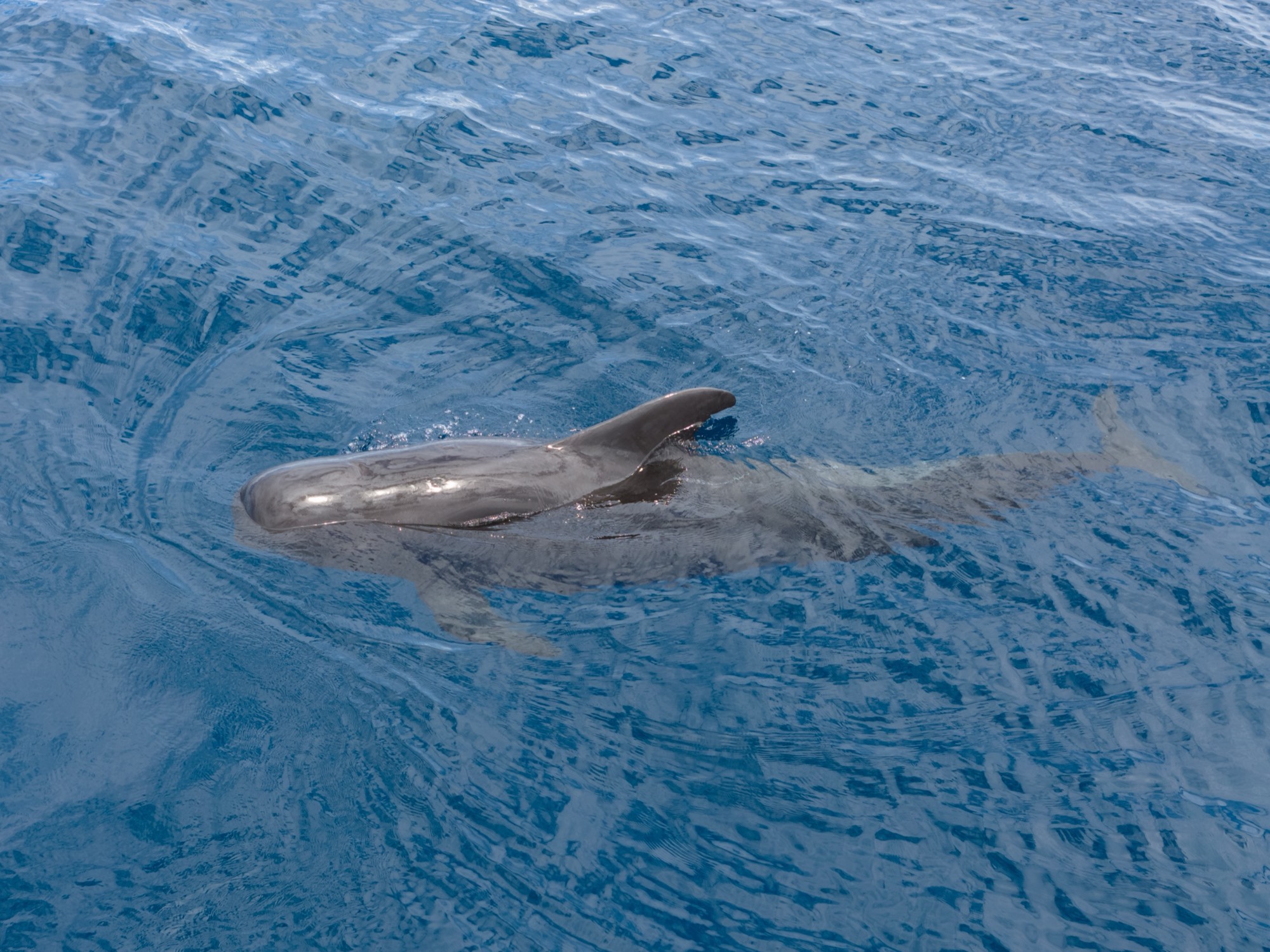
Pilot whales remain poorly understood in many ways, but one thing is clear: they are among the most social animals in the ocean. This sociality follows them all through their lives, but may come at a cost.
Recording: NOAA. NOAA Fisheries, NEFSC, Passive Acoustics Branch. 2023. Pilot Whale. NOAA Sounds of the Ocean
Overview
Currently, there are two species of pilot whale: the long-finned pilot whale and the short-finned pilot whale. They both belong to the Delphinidae family. The two species look a lot alike and can only be told apart by the length of their flippers, tooth count and skull shape. The long-finned pilot whale is found in cold-temperate waters, and the short-finned pilot whale in tropical and warm-temperate climates. Both species eat primarily squid, but also catch fish (especially some populations).
Pilot whales are one of the most social whales. They can commonly be found in groups of up to a few hundred. Most of their lives are spent in more intimate groups, however.
The basis of their social lives is formed in pods that average about 20 whales. These pods are matrilineal with social bonds lasting for generations. Pods are stable, with both males and females remaining part of the pod for life in most cases. Part of the believed reason for the very large aggregations of hundreds of pilot whales is to allow for males to mate outside of their own pods. An important reason for the rarity of mammalian males staying with their families for life is the risk of inbreeding. It seems like pilot whales solve this by regularly associating with other pods.
This sociality even extends to other species. Most often, they are sighted with bottlenose dolphins, but associations with other dolphins and whales are also common. These encounters can sometimes turn aggressive, with harassing behavior observed from the pilot whales.
Moving as one
Synchronization happens when at least two animals display the same behavior at the same time. Synchronous behavior is not rare among Odontoceti whales, and dolphins are especially known for their synchronous acrobatics. It is not an easy skill as it requires precise timing and coordination when performed at speed. It also takes place at lower speeds, however. Synchronous breathing is displayed in resting killer whales, for instance. Synchronous behavior is also often seen between mother and calf, likely used for bonding and for hydrodynamic advantages to the calf.
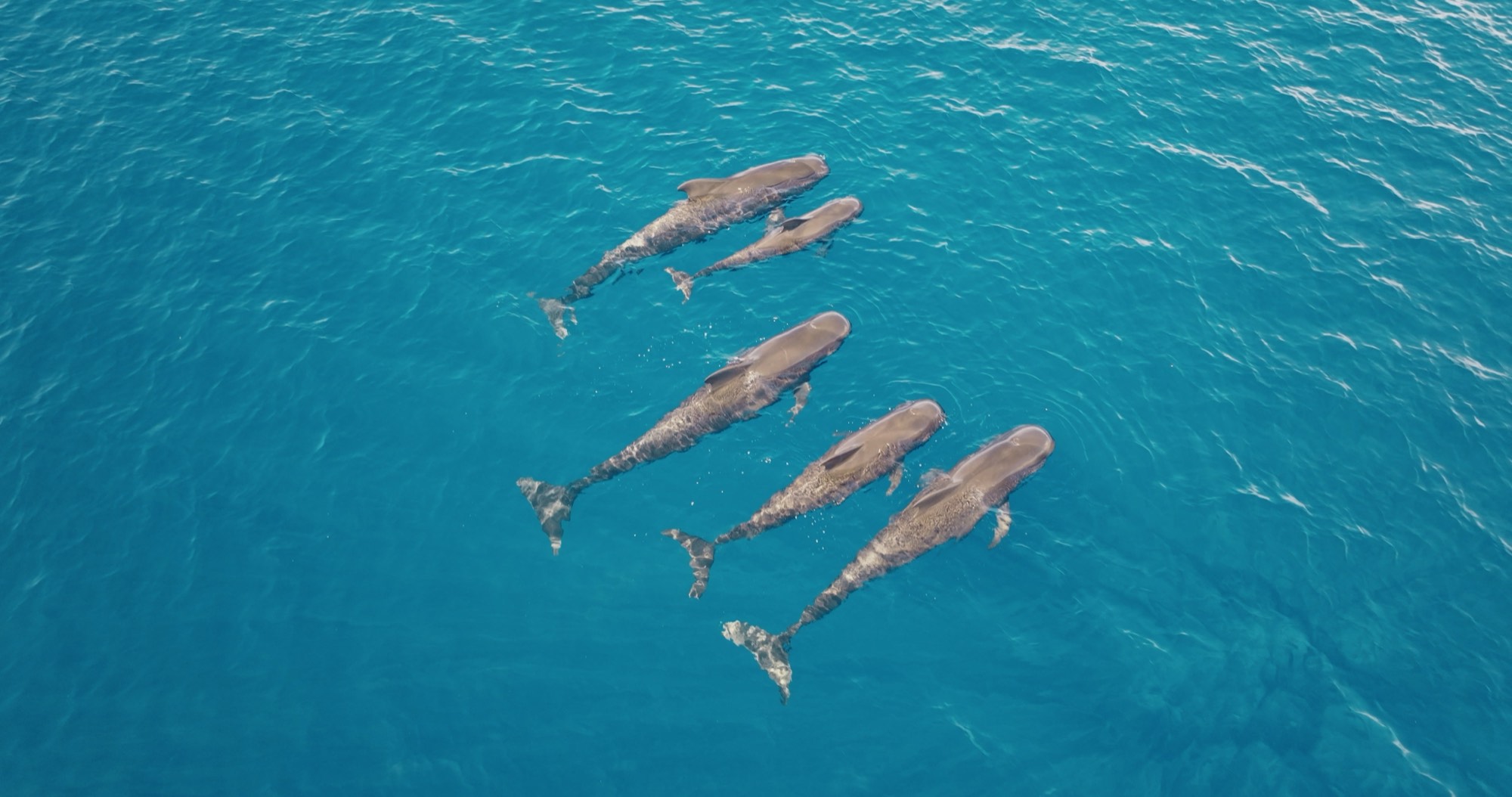
Pilot whales seem to synchronize their dives in pairs. When doing this, they display synchronous movements and dive for the same amount of time, while swimming close to each other. A study published in Marine Mammal Science showed that at larger group sizes of pilot whales, the synchrony is actually increased, not decreased, as one might expect. It is thought that the increased synchrony happens as a result of more complex situations. Group sizes of more than 30 animals are made up of several tight-knit matrilines. It is considered a more complex social situation for that reason. The study suggests that the synchrony’s function is to strengthen bonds between the whales, which would be more important in stressful situations. Stressful situations could be the increased group size (increased complexity and thereby stress), but also disturbances (from boats, for example) or the presence of predators. It is not yet known for pilot whales, but spinner dolphins react to predators by synchronizing and tightening the groups, so that might also be the case for pilot whales.
Mobbing
The acoustic environment of the oceans is one of constant activity. The communication is mostly directed at other animals in the same group, clan or even species. However, these exchanges are communicated on shared channels, so others might eavesdrop. A study conducted in the Norwegian Sea used playback of killer whale vocalizations to test the reactions of long-finned pilot whales. The study showed that upon hearing these vocalizations, the pilot whales shifted directions and moved towards the killer whale sounds. Observations of pilot whales chasing away the killer whales have also been made in these waters. There are two main theories for this approach: that the pilot whales treat the killer whale vocalizations as an advertisement for fish abundance or that they do it as a mobbing strategy. Researchers found no sign that the pilot whales actually started foraging after moving towards the killer whales, so mobbing seems most likely. Mobbing is when a group displays cooperative and aggressive behavior towards a predator - this can be harassing and intimidating. The mobbing strategy could be an anti-predator reaction or perhaps chasing the killer whales away for food access. In another study in the Strait of Gibraltar, the pilot whales were also seen chasing away the killer whales, even pursuing them. In this study, it was tested whether the reason for this was predation or competition. It was found that neither predated the other and that no food competition should occur. The theory was then that mammal-eating killer whales used to frequent these waters, but no longer do, so the defensive mobbing behavior of the pilot whales likely stems from those days and simply persists.
Drive fisheries
The pilot whale is a victim of the cultural heritage of the Faroese people. The Faroese term is grindadráp, which means pilot whale killing. This tradition can be traced back to the sixteenth century, and it is part of the culture in the Faroe Islands. About 900-1000 pilot whales are on average hunted every year. Currently, the estimated number of pilot whales in the North Atlantic is 778,000, which means that the annual number killed is probably sustainable. They are not considered threatened either, so the problem is another one. The question of sustainability, however, is separate from whether the harm inflicted on individual animals is acceptable.
The process of the hunt begins when a pod is spotted. The Faroese then rush to their motorboats and set out. The combined noise from the motorboats and manpower forces the whales towards the beach. Given that pilot whales are very social and stick with each other, this is likely not too difficult, although it can take hours. When the whales are forced close to the beach, humans now enter the water and attach metal hooks to their blowholes. They are then pulled onto the beach, which is almost certainly painful given their sensitivity to touch, and killed by a double-sided blade stabbed into the spinal canal. The guideline says to insert the blade between the skull and spinal atlas to break the spinal cord and then shift to the left and right to sever the blood vessels that supply blood to the brain. Despite the seeming protocol behind this, it does not kill the whale. The whale remains conscious for a short time until it has lost too much blood and eventually dies. The animals are then processed and divided among the hunters. In 2019, during a hunt in Vestmanna, 98 whales were killed in as little as 12 minutes.
The cultural significance of grindadráp deserves respect and some understanding, but the hours-long stress and pain to the animals cannot be morally acceptable. Traditions are important, but so is the updating of them in response to new knowledge.
Pilot whales are highly prone to mass strandings, with up to 470 whales stranding at once. This happens both singly and in groups, with the single ones often being sick. The less understood part is that when groups strand, seemingly healthy whales strand with them. Many theories exist to explain this behavior: maybe confusion or entrapment happens in shallow waters, geomagnetic anomalies could disturb their navigation, or the strong social ties of pilot whales lead them to follow a sick whale to land. Often, when large groups of whales strand, a rescue mission is set in motion. One of the most important factors is getting there quickly. These rescue missions require volunteers to manage tasks. Volunteers pour water over the animals to prevent overheating, rock them gently to keep their vestibular systems active, and carefully shield their blowholes from sand and water.
A study in Australia tried to discover the fate of recently stranded pilot whales. But whether a rescue has truly succeeded can only be judged over a longer timeframe than beachside observation allows. The study, therefore, used satellite transmitters to follow the whales after a rescue.
They proved that individuals reunited following the refloating, which confirmed that rescued whales can successfully return to their groups - a very important part of the rescue.
No one yet knows why pilot whales are so prone to strandings, but their strong sociality likely plays a role.