
Echolocation is a superpower that allows toothed whales to “see” in complete darkness, see inside their prey and catch unsuspecting fish. All by using sound.
Overview
The world we humans perceive is heavily influenced by our senses, which dictate our world. We only hear frequencies of about 20 hertz to 20 kHz, and we don’t hear well underwater. Cetaceans largely perceive the world through sound. To understand their world, we must try to understand how differently they perceive it.
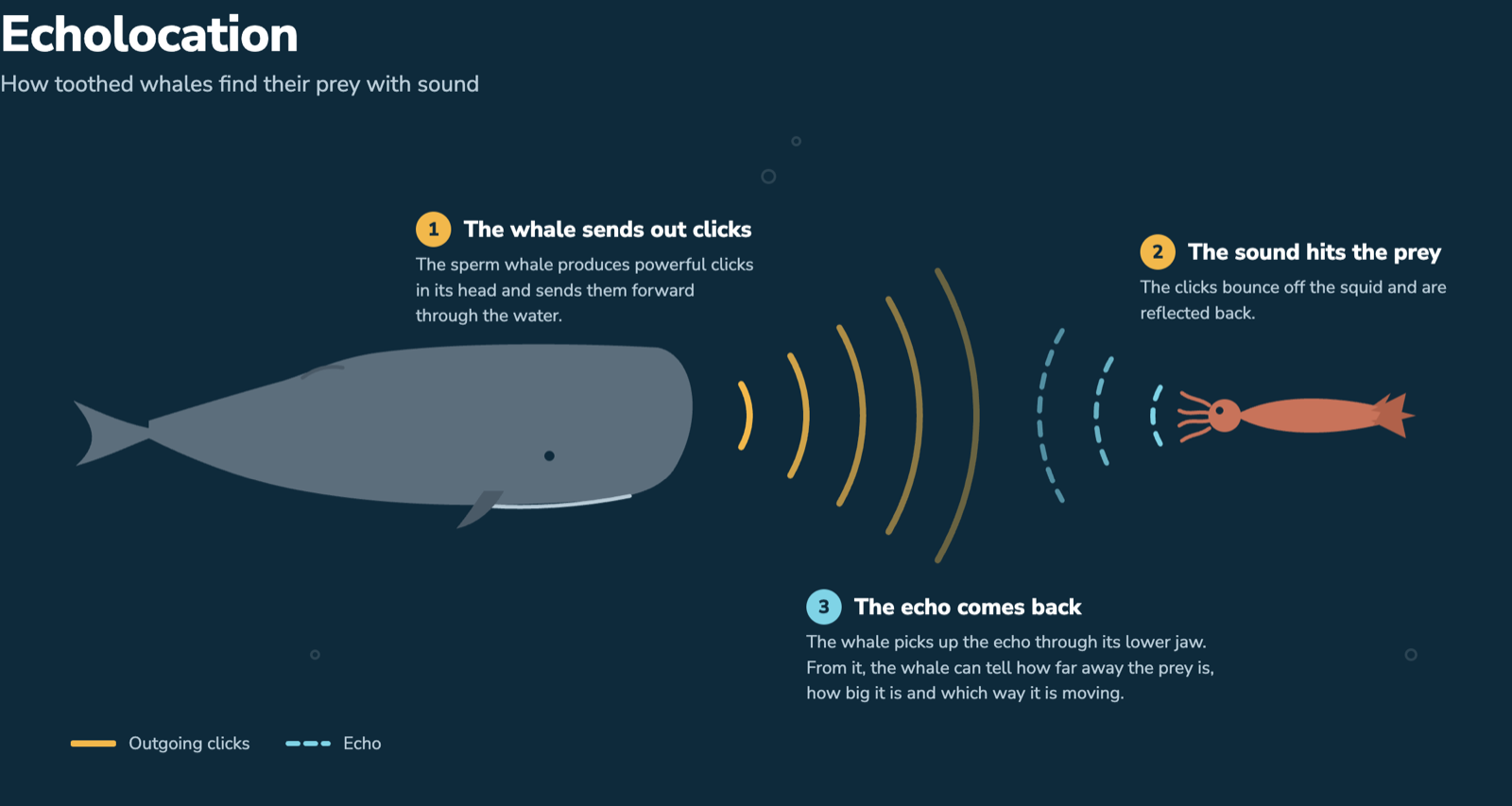
Echolocation is the emission of sounds and listening to the echoes. The sound waves will reflect off objects, and the echoes will then bring back a map of everything they encountered. This map happens because the echoes are modified versions of the produced sound, so by comparing the outgoing sound with the echo, you get the map.
To locate an object, the whale needs its range and direction. Range comes from the time delay between sending the click and receiving the echo, and direction comes from comparing the echo’s arrival at the two ears. Echolocation projects like a beam from the head, which can be directed in any direction. When looking for prey, the dolphin’s head will often shift focus and direction quite often.
Technically, any animal can produce sounds and listen for the echoes, like humans in a canyon. Echolocation is reserved for animals that are very good at this and use it on a regular basis, for instance, to hunt and avoid predators.
Mostly, echolocation has been thought of as “seeing” by hearing, but a recent study by Sophie Flem suggests it might be more like touching. By looking at and comparing preserved brains from different species, they found nothing noteworthy in the dolphins’ visual cortex, but instead found a strong connection between the inferior colliculus (structure in midbrain) and the cerebellum (the “little brain”). The inferior colliculus is active in auditory processing, and the cerebellum coordinates your movements. So it is like when we feel touch and coordinate our movements based on the touch feedback. That is a theory, however, we may never know what it is like to be a dolphin.
Sound production and reception
Much of the research on sound production and reception was made on captive dolphins, so this section will focus mostly on dolphins, but the mechanism is fairly similar in other toothed whales.
Echolocation is a sound system found in the nasal complex, with air as the primary driver behind the sounds. There is a structure beneath the blowhole that is called the phonic lips. Muscles keep the phonic lips closed until a pressure of air opens them (for about a millisecond) and rushes through the opening. The phonic lips close very quickly after the air has passed through, which causes vibrations. The tighter the lips are, the higher the frequency of the vibrations. These vibrations can be consciously controlled very precisely by the dolphins, which is why they have such a diversity of vocalizations. The vibrations are then passed on to the melon on the forehead of the dolphin and propagated in a directional beam. This beam can be thought of as our vision. We see best in a narrow field and then turn our heads or shift our eyes to adjust. It is the same in toothed whales. A narrow beam focuses more and increases the range.
Dolphins don’t have external ears, so exactly how they have such sharp hearing was of great interest to scientists. They can hear frequencies from 75 Hz to about 150,000 Hz (humans hear from 20-20,000 Hz).
It turns out that dolphins hear through their lower jaws. The sounds are received by fatty deposits in a hollow jawbone and from there carried to the middle and inner ears. The structure of the inner ear is actually similar to that of other mammals. Odontocetes localize sound at least as well as humans, and in some respects better. The sound is best received when directly in front of the dolphin.
Processing
The combined efforts of sound production and reception provide toothed whales with a very precise tool. Atlantic bottlenose dolphins have shown that they can detect a steel sphere of 7.62 cm suspended in the water at distances of more than 100 m. They can also tell the difference between cylinders only differentiated by 0.23 mm in wall thickness. Killer whales can tell the difference between fish species of the same size only by using their biosonar. Toothed whales do all this by reading the echoes. The mix of high and low frequencies in the echo can tell materials apart, because different materials reflect different frequencies differently. They can also analyze the highlight structure, which is the distinct mini-echoes that come back from different parts of an object. For example, a fish would send back little echoes from its swim bladder, bones and body surface. The timing between those creates a detailed picture of the fish.
These two mechanisms must be combined and processed when chasing prey. Chasing a small fish in dark water requires quick reactions and constant updates on the fish's location. As toothed whales close in on their target, they increase the amount of clicks they produce to adjust to the prey's escape. A harbor porpoise can produce 500 clicks per second when close to a target. If they responded to each individual click, their neural reaction times would have to be roughly 100 times faster than a human's visual reflexes, which isn't biologically plausible. A study by Heather Vance found that response times were similar to those of primates (eye muscles react in 50 milliseconds). This means that whales don’t react to each click, but rather process them in groups of tens of clicks, which makes their processing quite similar to that of visual animals.
Dolphins vs. bats
Echolocation has evolved in two very different orders of mammals, bats and toothed whales. In both cases, it has allowed them to carve out niches by being able to forage in the dark. Echolocation functions in the same way for bats as for dolphins, but there are differences. Bat signals are longer in duration (0.5-100 ms) than dolphins’ (0.1-10 ms) and are less directional. In dolphins, the echolocation is focused into a beam, which covers at most 10 degrees. Bats have a much wider focus, with beams covering 40-60 degrees. So it is kind of like a flashlight vs. a floodlight. This difference reflects the different prey and environment of the two. Bats hunt insects mostly just a few meters away, and those insects dart around with quick, unpredictable movements. A narrow beam would make it easy to lose “sight” of them, whereas a broader beam allows the bats to keep track of the insects. Dolphins, however, benefit from the narrower beam, because it keeps out clutter. The ocean is full of “noisy” objects, like fish, bubbles and the seafloor. A narrow beam limits the clutter. Second, a narrow beam is more powerful in the direction it faces (like a flashlight vs. a lightbulb), so that the dolphin can detect prey from farther away and “see” more clearly. They both adjust to broader beam widths when just about to attack, likely to make last-second adjustments to catch prey.
Echolocation might seem like an uncontrolled superpower rendering prey with no chance of survival. Prey species of both dolphins and bats have evolved strategies of their own to counter. Largely, there are two strategies: shape the body to minimize acoustic reflection or develop your own ultrasound hearing to avoid predators. Many insects have developed ultrasound hearing to counter the echolocation of bats, but in contrast, only very few fish can detect the echolocation of toothed whales. The shad can hear ultrasound and is quite rarely found in the stomach contents of dolphins, which indicates a higher survival of shads, likely because of their hearing.
It seems that harbor porpoises have found a way to catch shad despite their acoustic defense strategy. The way harbor porpoises do it is still unknown, but it might be tied to an adaptation of their sound production, like lowering the source level of their emissions.
The shad, dolphin and harbor porpoise perfectly illustrate the constant arms race between predator and prey, which has shaped so much of the biology we know today.