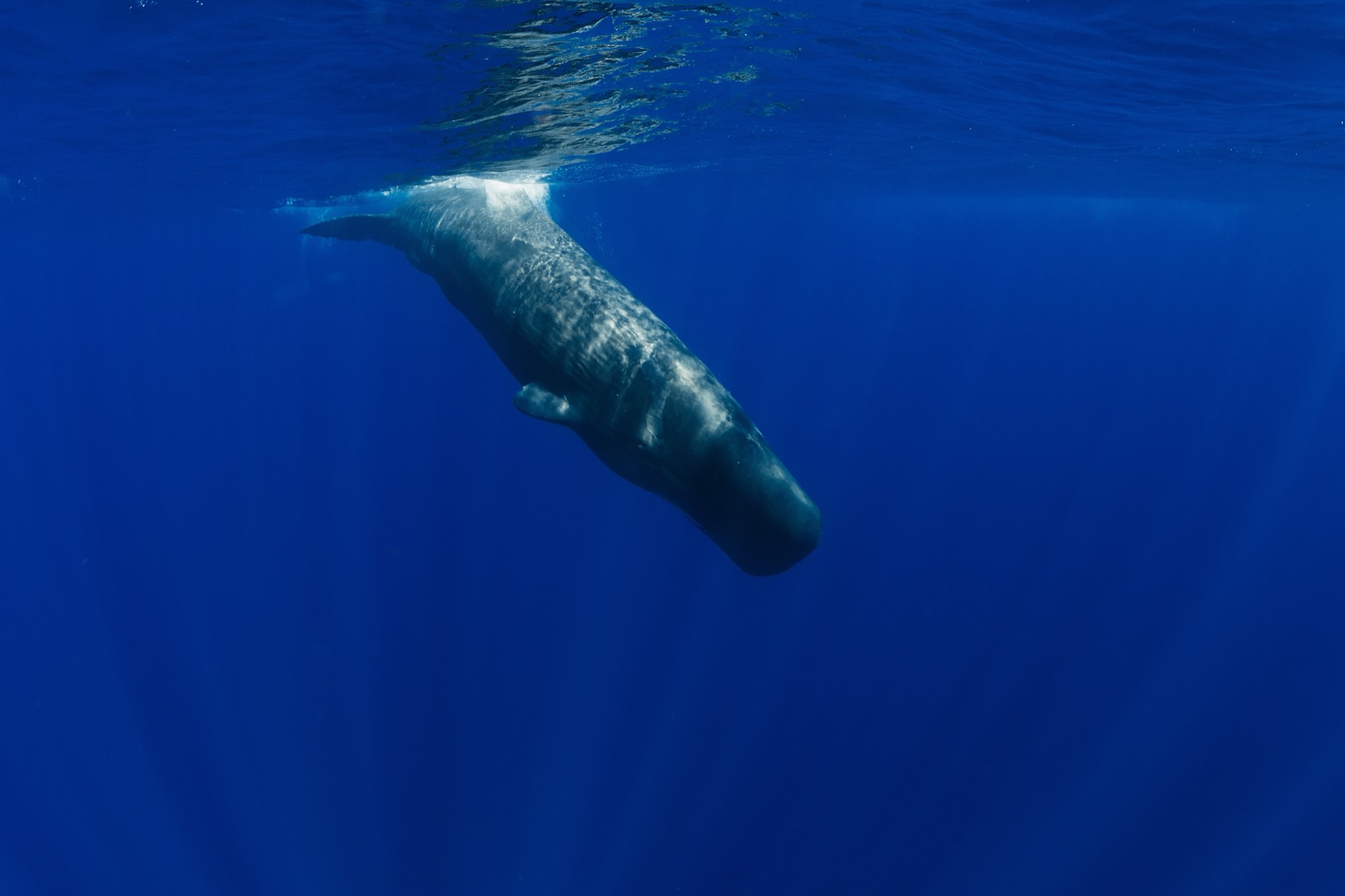
Everything your body does to keep you alive — breathe, circulate blood, stay warm — a deep-diving whale has rewired. It takes one breath, lets the ocean crush its lungs flat, slows its heart and turns down blood flow to its organs. Then it goes hunting.
Why dive?
As untrained humans, we might hold our breath for one or two minutes, although the record of natural underwater breath-holding is 11 minutes. 11 minutes is very impressive, but it is no match for the cetacean record of 222 minutes by a Cuvier’s beaked whale. Another Cuvier’s beaked whale managed to dive 2992 m deep, which is another cetacean record. While not all cetaceans dive this deep or for this long, diving is the way of life for these animals. Reaching this proficiency at diving has required many adaptations, and it also expends large amounts of energy. So why dive?
One advantage is access to deep-sea ecosystems. At the surface, whales face competition from birds, seals and fish, while in the deeper ocean they are mostly free of competition. Sperm whales regularly dive 400-1200 m deep in search of squid. This specialization has made them very effective predators, consuming an estimated 100 million tons of prey per year for the entire worldwide sperm whale population.
Sometimes diving can also represent better feeding opportunities. A study by Ari S. Friedlaender showed that fin whales diving deep had higher feeding rates. The study measured prey density and distribution, which showed that the fin whales increased their dive depths to feed on the densest prey patches. The modelled prey consumption of the fin whales quadrupled in the deep waters compared to shallow waters. Diving thus provided the advantage of denser prey patches.
Another reason is the evasion of predators. The surface of the ocean leaves you vulnerable to predators like orcas. Diving deeper than orcas means security. As described previously in this course, beaked whales display highly synchronized and silent deep dives to avoid detection by orcas. The deep part of the ocean thereby protects the beaked whales.
Diving adaptations
Cetaceans spend most of their lives underwater and are very comfortable there. Even diving very deep or for very long periods at a time. But like us humans, they are mammals, so how do they do it? They have a bunch of adaptations that allow them to be as comfortable underwater as we are above it. In this section, we will look at some of the reasons for this.
Oxygen storage
Improved breath-holding abilities are crucial for cetaceans wanting to make deep dives. An increased amount of oxygen found in the lungs, blood and muscles is a fundamental part of diving for cetaceans. The amount of oxygen found in the lungs depends on lung volume and the amount of oxygen stored in the lungs before a dive. The amount of oxygen found in the blood and muscles depends on blood volume and muscle mass, but also the oxygen-binding proteins hemoglobin (blood) and myoglobin (muscle). Increased blood volume and hemoglobin concentration are important factors in increasing oxygen storage. Perhaps the surest indicator of deep diving capabilities is a high concentration of myoglobin. This means that much of the oxygen is actually stored in the muscles for deep diving cetaceans.
In humans, the total oxygen store is 20 mL oxygen per kg body mass. Compare that to a sperm whale that frequently dives for 45-60 minutes and stores 81 mL oxygen per kg body mass. Only 5% of this oxygen is stored in the lungs, whereas 64% is stored in blood and 30% in muscles.
Cetaceans depend on many oxygen storage options and rely on increased oxygen pr kg body mass to sustain them on longer dives.
Metabolism
Cetaceans might reduce their metabolic rate to below their resting levels on very deep dives. The result is a significant reduction in energy requirements. Most of these energy savings are achieved through a decrease in metabolism in the gastrointestinal tract, liver, pancreas and spleen. These organs account for roughly 50% of the resting metabolism of the whale, so a lot is won by temporarily reducing their metabolic rate.
Reinforced airways
When diving deep, the body is put under massive pressure, which dramatically alters its functions. Water does not compress under pressure, but air does. So every air-filled cavity in your body is compressed. When we humans dive deep, our ribcage resists the pressure, which might lead to injury. Cetaceans have very flexible ribcages, and when they dive deep enough, cetaceans collapse their lungs. This removes the air that would otherwise be compressed and cause tissue damage. The distal airways are reinforced with cartilage, so they stay open while the lungs collapse. This lets air move out of the alveoli to the bronchi as the lungs are compressed. By pushing out the air from the alveoli (place of gas exchange), the whale avoids gas exchange during the dive, which prevents excess nitrogen from being absorbed. This is an important factor in avoiding the bends. It also protects tissue by letting air move around.
Oxygen supply
Muscles need oxygen to sustain traveling underwater. Since most deep divers collapse their lungs, they cannot rely on the lungs for oxygen storage. Cetaceans have found a smart way around this. Deep divers store over 90% of their oxygen in their blood and muscles, and only a small share in their lungs. In humans, about a quarter is stored in the lungs. When cetaceans dive, their heart rate falls (a tagged blue whale’s heart rate dropped to only 2 beats per minute), and their movements become slower and more gliding than swimming. When swimming up the water column, the opposite happens. The heart rate rises and movement becomes more active. This control of heart rate saves crucial energy on deeper dives. The lower heart rate pumps less blood, so the blood flow is prioritized to the most important areas like the heart and central nervous system. The blood flow to less important areas like the skin and gastrointestinal systems is reduced. The result is that cetaceans can dive deep and for extended durations at a much lower cost.
Anaerobic metabolism
Cetaceans rely mostly on oxygen-supported metabolism. This kind of metabolism is called aerobic because it happens with oxygen. The other kind is called anaerobic and is accomplished without oxygen. Their job is the same: release energy from the consumed food in the form of ATP (sort of energy currency). Aerobic metabolism is highly preferable, because it produces roughly 18 times more ATP than anaerobic metabolism. Additionally, its waste products are much less harmful to the body. Therefore, diving is heavily dependent on oxygen, but it is possible to extend dives by also employing anaerobic metabolism. It comes at a price, though. The waste products of anaerobic metabolism must be processed before the next dive, so the time between dives increases. It is therefore most likely only used for extreme dives. The most efficient way is by far aerobic metabolism, allowing for more frequent dives and better energy efficiency.
The bends
Whales have to deal with very high levels of pressure daily. One kilometer underwater and the body is put through pressure levels 100 times the normal amount. At these pressure levels, any air-filled space is at risk of compression or collapse. One way whales reduce this risk is through regional collapse of the lungs. As pressure increases with depth, the compressible alveoli — the tiny sacs where gas exchange happens — are squeezed and collapse first. The air they held is forced upward into the stiffer, cartilage-reinforced airways (the bronchioles and trachea), which resist collapse and where no gas exchange takes place. The result is effectively two zones: a collapsed, blood-rich region that can no longer exchange gas, and an air-filled region that no longer touches the bloodstream. Because the air is now held away from the gas-exchange surface, very little nitrogen passes into the blood at depth. This limits nitrogen uptake and lowers the risk of nitrogen narcosis and the bends.
But do whales get the bends? Whales mostly avoid the bends, but there are, however, indications of whales getting the bends. Some stranded whales have been found with gas bubbles in their tissues. This could indicate that they died from the bends. One suggested reason for this is loud underwater noises such as sonar or oil drills, which made the whales quickly ascend to the surface. This quick ascent would leave them vulnerable to decompression problems.
It is not uncommon for marine mammals to exceed their aerobic dive limit (ADL), which is the diving duration supported entirely by oxygen. Diving beyond the ADL duration incurs an increase in the waste product lactate, because of the reliance on anaerobic metabolism. It is the same sensation of burning legs we know from an exhausting run. Increasing the duration of a dive should require the animal to rest for longer periods between dives to process the lactate. However, a study by Nicola J. Quick analysed 3680 dives by Cuvier’s beaked whales and found that maybe these whales have found a way to navigate around this. The longest 5% of dives showed no relationship to breathing intervals either before or after the dives. Cuvier’s beaked whales therefore seem to avoid the penalty of having to extend resting periods between deep dives. The study suggests that they do this by having low metabolic rates, high oxygen storage, and a good acid-buffering capacity to handle the lactate from anaerobic metabolism. This allows them to effectively exploit their deep-ocean foraging grounds.