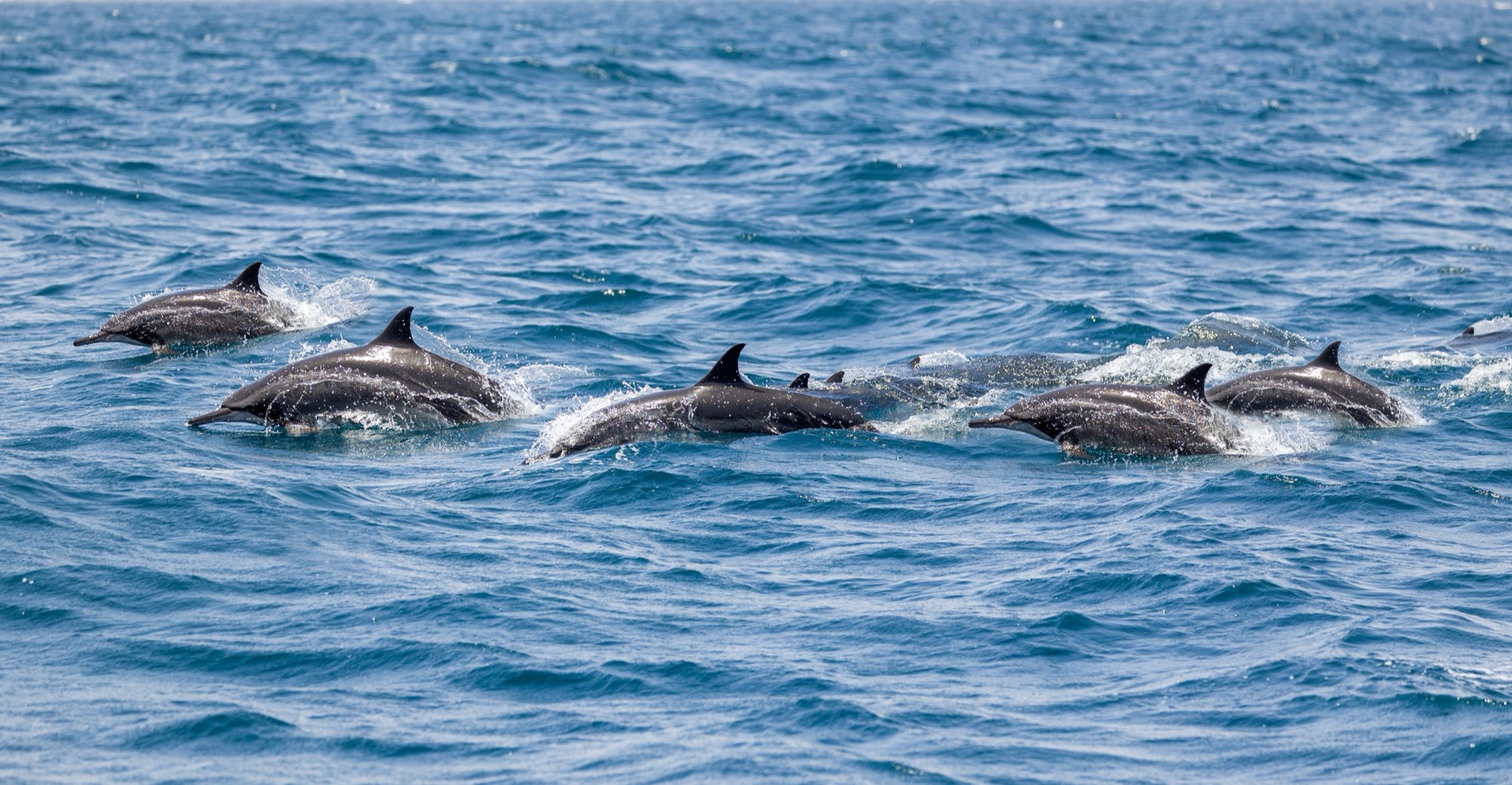
Every bottlenose dolphin has a name. Not one given by humans, but one it creates for itself: a unique whistle that other dolphins can copy to call it. What else are these "cognitive cousins" of ours capable of?
Recording: NOAA. NOAA Fisheries, NEFSC, Passive Acoustics Branch. 2023. Bottlenose Dolphin. NOAA Sounds of the Ocean
Overview
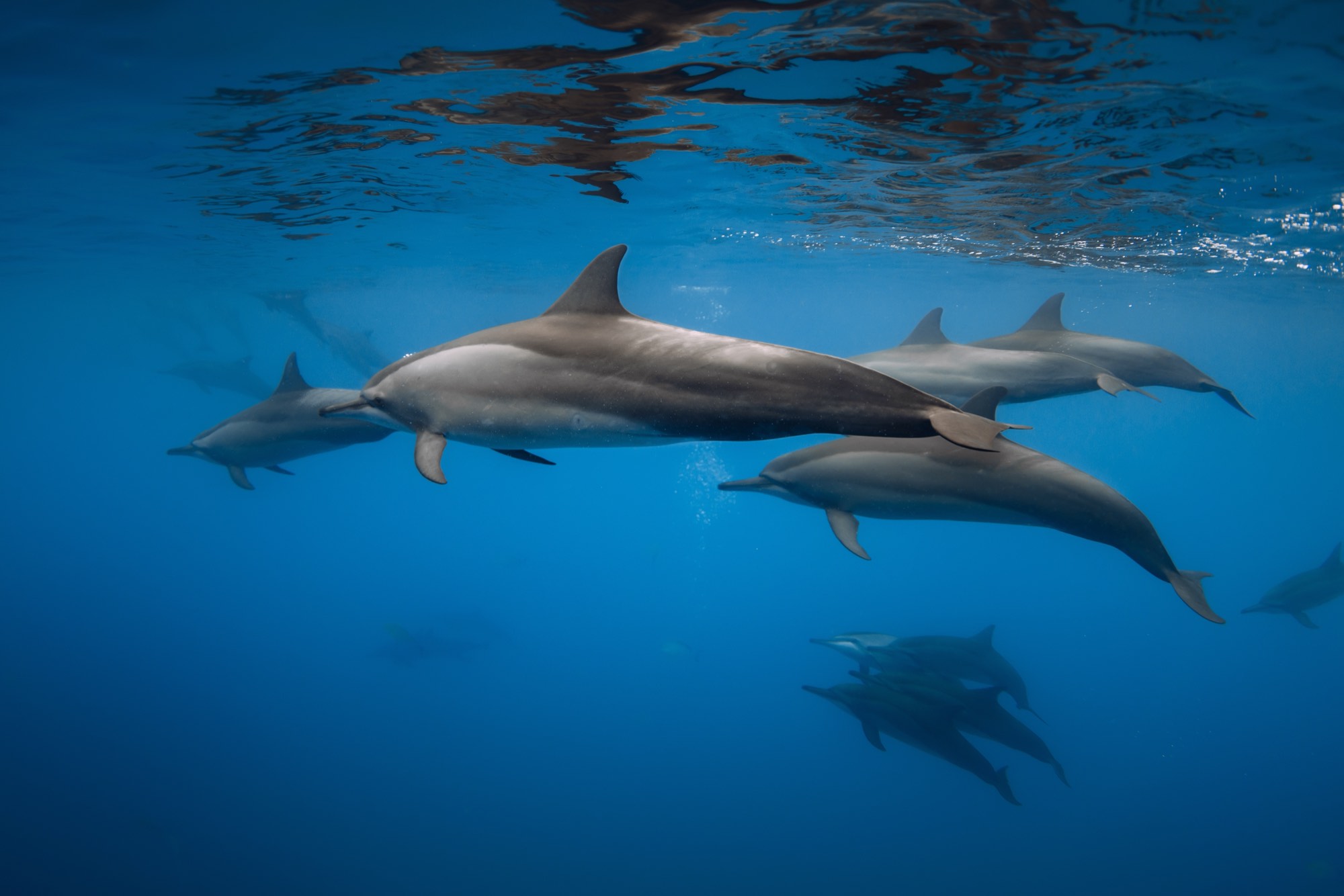
The family known as Delphinidae is incredibly diverse, with around 37-38 species from the common bottlenose dolphin to the orca. They display a great variety of looks, sizes and behaviors. For many of the species belonging to this family, not much is known. However, the bottlenose dolphin and orca are particularly well researched and are among the best known of all cetaceans. All dolphins are social, but in which way differs greatly between species and between coastal and offshore dolphins. It ranges from small, tight-knit groups to huge herds numbering thousands of dolphins. The ones we know most about are the coastal dolphins. Among these, some clear long-term relationships have been recorded, and it generally seems that bonds among females are strongest. However, in bottlenose dolphins, strong male-male relationships occur when they form alliances often lasting for years. Dolphins are also regularly seen traveling with different species. The northern right whale dolphin and bottlenose dolphin are sometimes seen traveling with baleen whales and pinnipeds (seals, sea lions).
Dolphins are known for their seeming playfulness. They have often been observed surfing in coastal areas, and riding the bow-wakes of large boats or even large whales. This can be accompanied by their impressive acrobatics with high leaps and flips. In the case of the spinner dolphin, it may even be spins with 7 rotations performed in the air!
Social lives of bottlenose dolphins
The commonality between bottlenose dolphin society is the fission-fusion grouping style. This means that the composition of the group is highly fluid and can change both daily and hourly. The groups forming will usually be small. Bottlenose dolphins live in groups of potentially thousands in the open ocean, but form groups of about 12 when in coastal regions. Some of the best-known areas inhabited by bottlenose dolphins are Sarasota and Shark Bay. Characteristics of these areas were that females have a large network of other females, they mostly group with a particular set of females in “bands”, kind of like established friends. And a minority of females don’t belong to any one band. These bands can remain stable for many years. For males, the picture is a bit different. Male bottlenose dolphins will team up in alliances in groups of 2-3. These alliances can group up and become second-order alliances with up to 14 dolphins, which is quite common. The groups happen as a tactic to force female dolphins to mate with them. They will herd the female and isolate her from other males, thus leaving them as the only choice. Males in these areas form extremely strong bonds, spending almost all of their time together. In Sarasota, these male pairings may last as long as 20 years or until death. Mostly, these alliances compete against each other for access to females. However, observations of one alliance helping another alliance attain a female have been made. This could be an act of altruism, but it is uncertain.
Relationships vary between populations. In the Shannon Estuary, there is no evidence of male alliance formation. The strongest associations among the males were with females. A more mixed-sex society, therefore, seems to be the social structure there.
Our cognitive cousins
The dolphin researcher Louis Herman thought of the term “cognitive cousins” because of the cognitive abilities of dolphins seemingly being at the level of great apes and humans. Dolphins have the second-highest encephalization quotient, only behind humans. Bottlenose dolphins are one of the most researched cetaceans, because of their coastal habits, but also because they can be caught and kept in captivity. Many incredible behaviors have been documented in bottlenose dolphins. Here a few will be highlighted:
Language
Bottlenose dolphins are among a few select species that display an understanding of a rule-based symbolic artificial language. In studies by Louis Herman, it was shown that bottlenose dolphins are capable of understanding both semantic and syntactic information. They tested whether the dolphins could understand differences in word order. For example, the difference between “surfboard person fetch” and “person surfboard fetch”, the difference being whether to take the person to the surfboard or the surfboard to the person. It turns out that dolphins can tell the difference. They can even understand symbolic references to absent things.
Tool use
In Shark Bay, Australia, a group of bottlenose dolphins uses marine sponges as foraging tools when hunting for fish along the seafloor. It is likely used as protection for their rostrum when searching for prey on the seafloor. Tool use is known among some animals like the chimpanzee, crows and elephants, but it is still very rare. The behavior in dolphins is known as “sponging” and is taught from mother to daughter.
Episodic memory
The definition according to WebMD: “Episodic memory is the ability to recall personal experiences, including where and when the event happened, forming part of a long-term memory”. There is evidence for episodic-like memory in bottlenose dolphins. It is episodic-like because, so far, the only way to test it is through language. When humans think back on a memory, much of the information in the memory was trivial at the time, but was recorded anyway. This is the incidental encoding characteristic of human episodic memory. In the study, they showed that dolphins could do the same by using incidentally encoded information on “where” and “who” in order to solve a memory task. This suggests that dolphins can encode and recall incidental information, which is a part of human episodic memory.
Call me by my name
One of the pillars of human language is the use of naming or labeling. This feature is very rare in animals. The use of alarm signals is a form of labeling, but these signals are mostly inherited. More complex use of labels occurs when they are acquired through vocal learning. It is thus possible to create distinctive vocal repertoires, as seen in songbirds, pinnipeds, cetaceans, elephants, hummingbirds, bats and parrots. Bottlenose dolphins do something extraordinary, however. They create their own “signature whistles”. A signature whistle is a personal and learned signal that identifies the whistler. The whistle has its own frequency modulation pattern and can be recognized by other dolphins. Dolphins likely can’t tell voices apart as terrestrial mammals might. It has been suggested that the pressure changes according to dive depth change the voice, so it cannot reliably be recognized. They therefore need to distinguish each other by unique signals.
The signature whistle is almost exclusively used by the owner, which allows it to be effectively used as a label for that specific dolphin when copied by others. Other dolphins can thereby contact individual dolphins by their signature whistle.
Animals have been shown numerous times to cooperate in hunting, dominance relationships and reproduction. Humans communicate vocally, but how animals organize and coordinate is still not fully known. Bottlenose dolphins are highly cooperative in the wild in both foraging and alliance-making. A study by Stephanie L.King investigated whether dolphins use vocal signals in cooperation. The experiment was designed to have two dolphins swim across a lagoon and press their own button within 1 second of each other. There was one male pair and one female pair in the experiment. The two pairs both coordinated their behavior using vocal signals. The use of whistles led to “significantly shorter button press intervals,” according to Stephanie L. King. The dolphins used whistles just before pressing the buttons, likely to coordinate exactly when to press. This study shows the remarkable ability of dolphins to coordinate and cooperate, but to what extent they use it in the wild is still unknown.