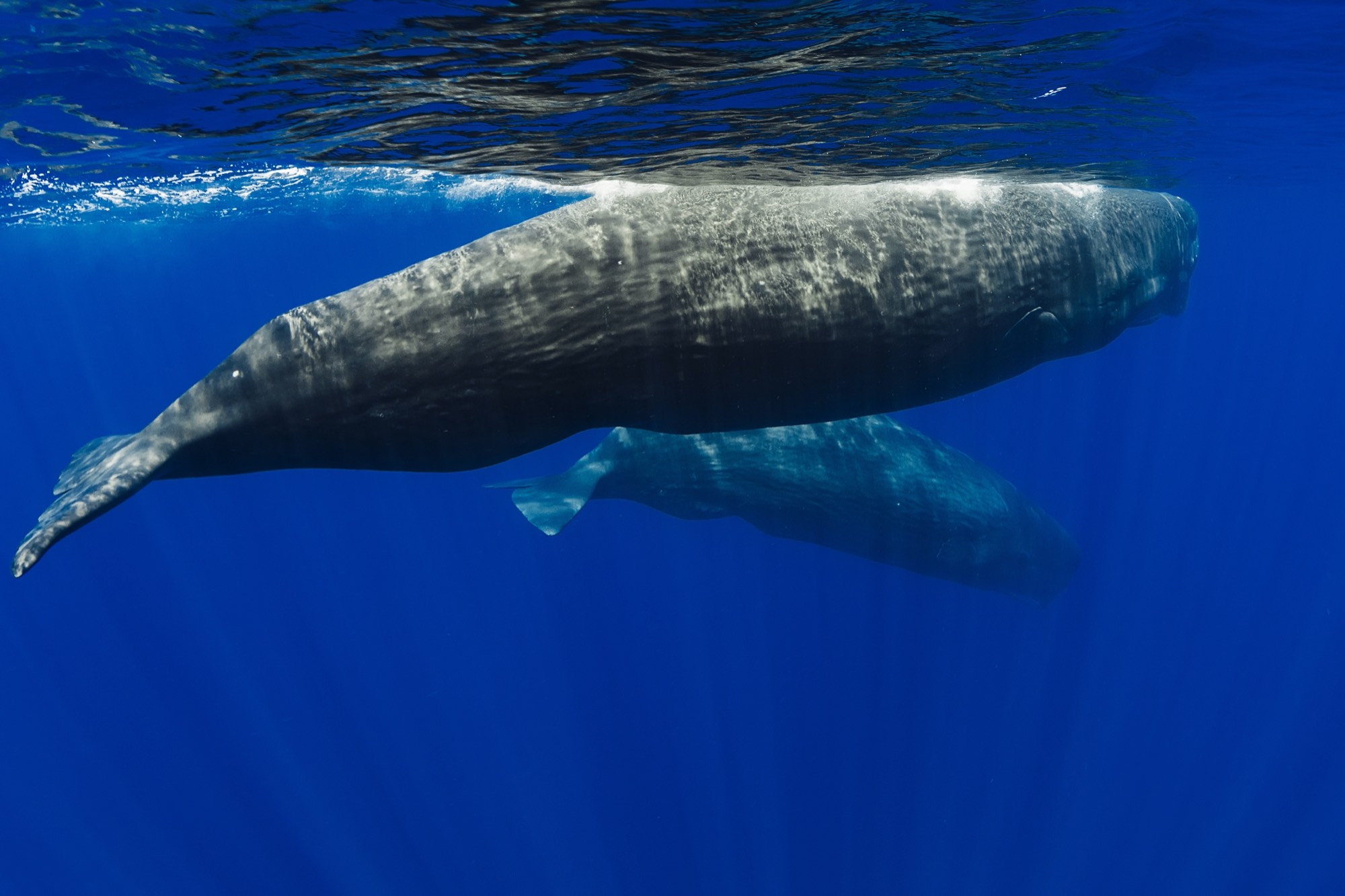
Sperm whales hunt in the deep, dark ocean, where they use their strong echolocation to find squid. They are the masters of this depth and consume 100 million tons of biomass per year!
Recording: NOAA. NOAA Fisheries, NEFSC, Passive Acoustics Branch. 2023. Sperm Whale. NOAA Sounds of the Ocean
Overview
The name “sperm whale” likely comes from whalers’ misunderstanding of the function of the oil found in the whales’ foreheads. The lives of sperm whales show a remarkable semblance to elephants’. They are both large, have large brains, display marked sexual dimorphism, large ranges, matrilineally based social systems, and the same breeding style of roving males.
Especially, the sexual dimorphism is extreme in sperm whales. The males weigh approximately 3 times as much as females and grow 5 m longer. The largest and most characteristic part of the sperm whale is the nasal complex, which might be as much as 1/3 of its total length. In this complex are the spermaceti organ and the “junk”, which is oil and connective tissue.
The spermaceti’s primary job is to facilitate the sperm whale’s clicks, which are used in their extremely powerful echolocation system (highest sound pressure level of any animal). Sperm whales use almost exclusively clicks for both hunting and communication, as opposed to, for example, dolphins, which use a wide variety of sounds.
Another function of the spermaceti organ is also proposed. Herman Melville’s book of fiction about the sperm whale, Moby Dick, was inspired by sperm whales sinking whaling ships by ramming them with their heads (few documented cases, however). These powerful weapons might have evolved as a head-butting contest between males. They might then serve as weapons in male-male dominance relationships.
Feeding
The sperm whale is a deep-sea specialist with most of its hunting taking place in deep waters between 200-1200 meters. The prey of females is made up of mostly squids weighing anywhere from 0,1-10 kg. The males eat the same, but tend to choose the larger ones. Both sexes sometimes also consume sharks and rays. The exact mechanism by which sperm whales forage remains unclear. It is hard to follow and observe them at the depths they frequent. However, much of the overall pattern is known. The whales typically dive almost vertically down the water column to depths of 300-800 meters. Loud regular click-trains, with about 0,5 seconds between, are sent out to locate the prey, hundreds of meters away, in the dark. Interspersed in between these click-trains are “creaks”. Creaks are sounds made up of up to 220 clicks per second. They are thought to be made when the whale is very close to the prey and are used as indications of feeding.
It is also suggested that vision plays a role. Most of the hunted squid are bioluminescent, so echolocation is perhaps used until vision is established, and then the whale simply captures it by vision. The bioluminescent remains of previous prey on the whales’ lower jaw may even attract other squid. The whales are thought to suck their prey into their mouths.
The dives most often last for about 40 minutes, but may reach over an hour. When they are done feeding, they will ascend steeply and rest and breathe for about 8 minutes at the surface.
Coda
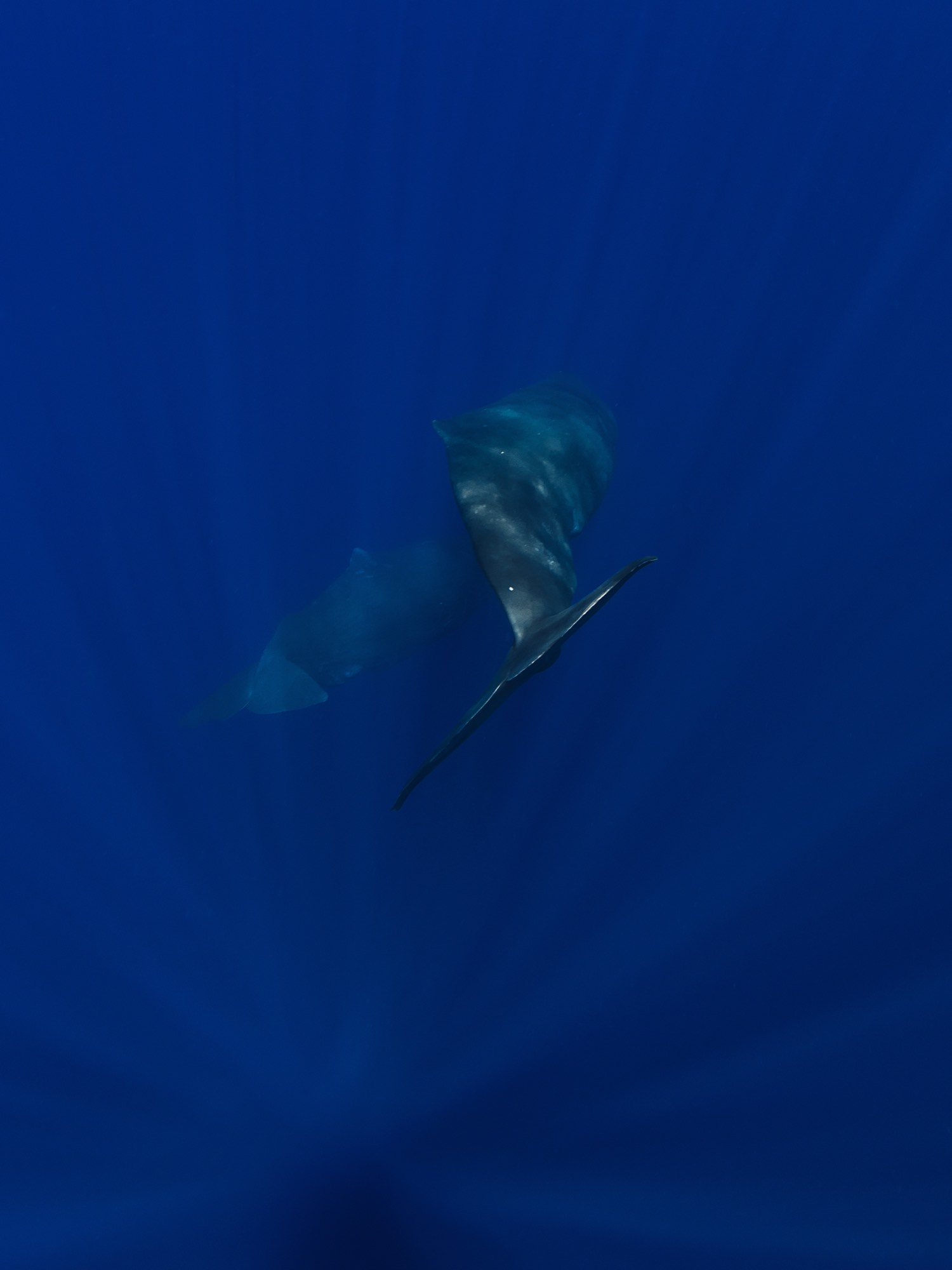
Sperm whales use their clicks for everything. They are heavily featured in foraging, but as opposed to dolphins, who use whistles for communication, sperm whales also click to contact each other. These are called “codas” and are a Morse-code-like system of clicks lasting about 0,2-2 seconds. An example: click-click-click-pause-click. Sperm whales can differentiate between communication clicks and echolocation clicks. The ones used for echolocation are more powerful and directional. The males rarely produce codas, and the very young whales “babble” instead of actual codas, so codas are essentially for adult females.
The whales mostly make their codas at or near the surface or when beginning a foraging dive. They can be in touching distance or a few hundred meters apart. The function of the codas seems to be for social bonding. The same codas are shared among all the members of the social group.
Interestingly, these codas are shared in large sperm whale clans. For example, off the Galapagos, there are two fundamental codas: click-click-click-click and click-click-pause-click. These two vocal clans were named “Regular” and “Plus-one”. It turned out that these dialects marked two different societies. The social units of the Regular clan only associated with each other, and the same went for the Plus-ones. Despite them frequently visiting the same areas. The codas are probably learned from the mother and the other females in a young whale’s community. These clans were different in other ways, too. They differed in group movements, feeding success and reproductive rates. Just as with the dialects, this must be a result of social learning and maybe a form of culture.
Highly social females and lone males
The social lives of sperm whales are highly dependent on sex. This section is therefore split into female and male:
Females
Female sperm whales form meaningful bonds that last for life. She will always be in the company of other whales and often relatives. The family unit of ten or so females and their calves forms the basis of their society. Often they stay in the same family unit for life, but emigrations happen. These small social units are a part of a larger picture of clans. Each social unit belongs to a clan and can form temporary associations with other clan social units. It is therefore not rare to see groups of much more than 10 at a time.
Within the social unit, everything is done together and in a very cooperative fashion. The young are taken care of as a unit. Females even suckle calves that are not their own - very rare among cetaceans. The calves cannot dive deep, which means that they have to separate from the mother when she is foraging. This is a very dangerous situation for the young whale. The adult females solve this by staggering their dives. This way, there is always an adult female babysitter to protect the calf.
Another benefit of communal living is the anti-predator defense. The most fearsome predator of sperm whales is the orca. When attacked, the sperm whales form defensive patterns. There is the “Marguerite”, which is a formation where all the adults form a circle with their heads in the center, using their tail flukes for defense. The other is the “heads-out” formation, in which the tails are in the center, and the jaws are the defense. Common to these formations is that the calves are protected in the center. Females will risk their lives in the defense of unit members.
Females also stood by each other during whaling attacks. It is even reported that they tried to break the harpoon lines and attack the whaling boats in defense of each other.
Their loyalty to each other and their calves was sinisterly used by whalers, who injured the calves and then slaughtered the females who stood by them.
Males
Young males leave their mother’s social unit when between 4-21 years of age. After this, they form loose aggregations with other males about the same age and size. Males grow into their thirties and are not fully mature until 50. As they mature, they move to higher latitudes and become more and more isolated. The largest males are usually alone. They are sometimes found together, but rarely for more than a day. Males have been seen aiding in the defense of female sperm whales, but never each other.
The communication of sperm whales presents a unique opportunity for scientists. Many codas are described, but the meaning behind them remains unclear. This is where Project CETI (Cetacean Translation Initiative) enters the picture. Project CETI wants to listen to and translate other species’ communication. The mission began in 2020 with the sperm whale. The project employs aerial drones, whale tags, and underwater autonomous gliders to record the whales’ sounds and movements. They will attach a suction-cup sensor to the whale, which is designed to avoid disturbing the whale. The tag then records audio through hydrophones as well as pressure, motion and orientation. After a while, the tag detaches, and now the data is ready to be analyzed through machine learning models made with the purpose of finding patterns in whale speech.
The team is highly interdisciplinary, with eight different disciplines represented - these include linguistics, robotics and artificial intelligence.
So far, they have tried to identify grammatical structures and even discovered a “sperm whale phonetic alphabet”. A paper produced by Project CETI showed that sperm whale communication has contextual and combinatorial structure. By looking at long-term recordings of nearly 9000 codas, they found that sperm whales make sub-second adjustments to their speech and add clicks to codas depending on context.