The oceans seem very inhospitable at first glance, with their almost endless horizons, violent temperament, infinite darkness, and eerie silence underwater. So how is it that some mammals feel at home in this environment?
Water’s special sauce
What makes water special? It is just two hydrogen atoms and one oxygen atom bound by covalent bonds. Yet it is the environment for some of the largest animals to ever grace this earth. Many of the specializations of cetaceans are based on the qualities of water. Water is 840 times more dense than air, which means that animals in the water essentially live without gravity. This, in turn, means that weight is no longer a limitation. It is actually an advantage. The larger you are, the easier you move through water. That is because drag grows more slowly than body weight, so each added kilogram of a whale costs less to move. The larger you are, the easier it is. Another advantage of large size is heat retention. Heat is generated internally but lost through the surface, so it is better to have a smaller surface area relative to volume - something that is seen in larger animals. The opposite is true for smaller animals, so it is generally advantageous to be large. The reason this matters so much is that water draws heat away from the body about 25 times faster than air.
Now we will try to step into another world. Imagine for a second that you are a dolphin. You swim around looking for a fish to eat. You must constantly orient yourself, looking up, down and to the sides of the 3D ocean world. The water is murky, so you can’t really see much, and every time you go a bit deeper in the ocean, it only gets even darker. You also feel a small increase in pressure every time you dive deeper for a fish. Luckily, you don’t need much vision because you emit high-frequency sounds that travel back to you with information, and you now know exactly how far away the fish is and what type it is. You keep echolocating as you get closer to the fish until your pincer-like jaws catch and swallow it whole.
One thing that works better in water is sound. Sound moves 4 times faster in water and much farther, which makes echolocation one of the great inventions of nature. Sound absorption is weaker for lower frequencies - this partly explains why the low-frequency calls of blue whales can potentially be heard from thousands of kilometers.
Underwater mammals
Most would probably be able to recognize a mammal, but what actually makes it a mammal and not something else? Some of the defining features are that they nurse their young with milk, they are endothermic (which means that they generate body heat internally), and the presence of a four-chambered heart. Hair is also something that is connected to mammals and whales actually do have hair. For instance, dolphins have whiskers in the womb but quickly lose them when born. A feature that does not get much attention on land but becomes a big priority in water is breathing in oxygen. Many ocean creatures like fish rely on the oxygen found in water (about 0,5-0,9% in seawater) by utilizing gills. Cetaceans, however, must come up for air. This would seem like a big disadvantage at first. It both limits the time spent foraging and presents predators with an opportunity - think, for example, polar bears preying on seals and beluga whales when they come up for air. But it actually has a few advantages. Oxygen at the surface is about 21%, which makes it a lot richer than that found in water. Oxygen is paramount in energy production, which means that mammals can expend much more energy than fish. Especially in the deeper waters that are less oxygen-rich. This creates a strong niche for mammals like the sperm whale that often forages at depths of 1000m.
Cuvier’s Beaked whales
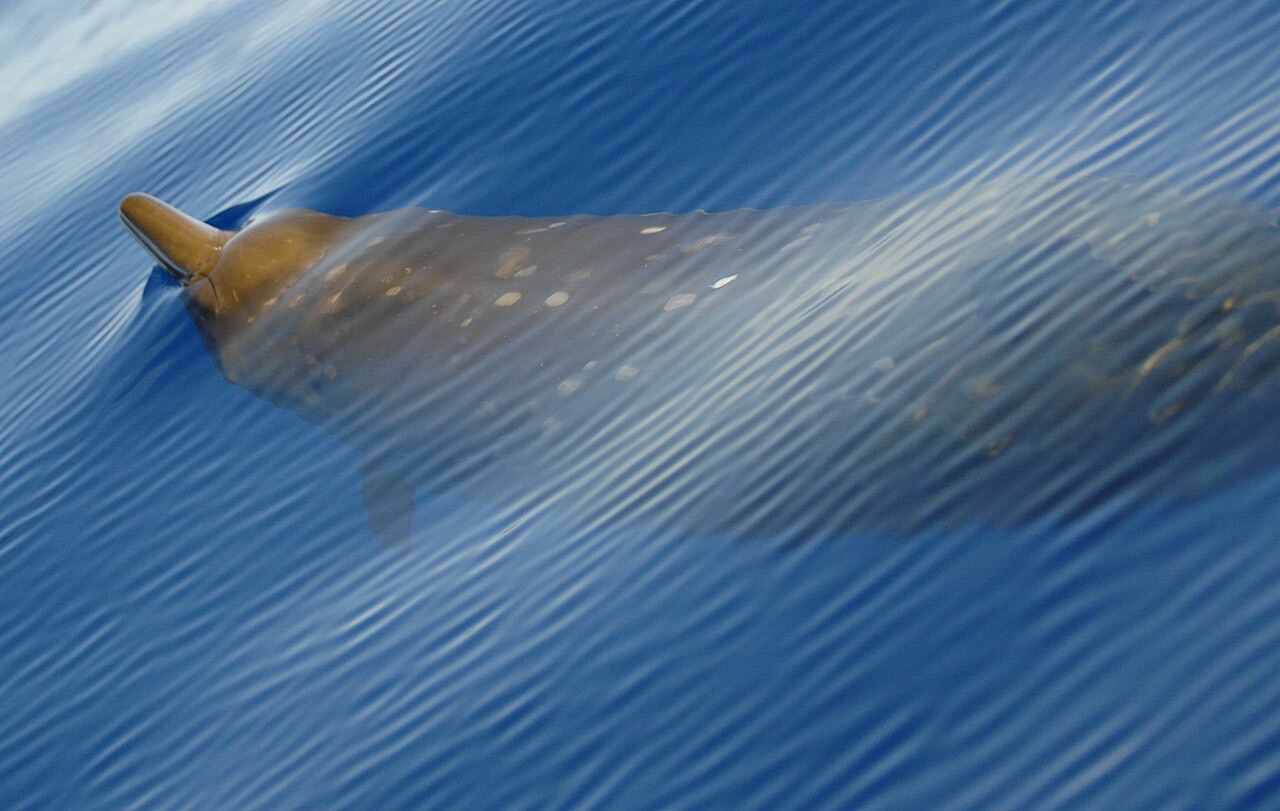
One of the most extreme cetaceans in terms of adapting to the oceans is Cuvier’s beaked whale. It has a wide distribution and is found in the open ocean. A typical foraging session for Cuvier’s beaked whale can happen both day and night and consists of routine trips to depths of at least 1000 m. Typically, they don’t start echolocating before reaching 400m of depth. This means that they likely first actively hunt at that depth, where it is completely dark and already imposes quite a harsh pressure on the body. At these depths, the prey they feed on is squid, fish and crustaceans. Cuvier’s beaked whale is currently the most impressive diver of all cetaceans. Its record dives were 2992 m deep and 222 minutes long. They really push the limits of what is possible for mammalian physiology. What makes this doable is the same changes that many whales have made. In Cuvier’s beaked whale, it is just more extreme. The oxygen store in whales is located in the lungs, blood and muscle, and it is much larger than in us humans. Particularly, the myoglobin (protein in muscles that binds oxygen) count is much greater in deep-diving marine mammals. And the lungs play a much smaller part.
The other big factor is the pressure. As humans, we feel uncomfortable quickly at depth because our air spaces, especially in the ear, make it very obvious to us that the pressure inside of us is very different from the one outside. Cuvier’s beaked whales solved this problem by having vascular structures that can engorge and make the airspace much smaller, which decreases the pressure difference. Another problem is the lungs. They probably get around this by having lungs and chests that are very compressible. The lungs can thereby collapse without injury. This means that they can tolerate the otherwise crushing pressure and avoid nitrogen narcosis.
Studying cetaceans
Given that cetaceans spend about 95% of their time underwater makes it difficult to study them. Much of the early knowledge came from the fisheries and the whaling industry. Some of these were whaler-naturalists. Knowledge of behavior was important to whalers who would, for example, injure a sperm whale calf knowing that the mother would not leave its calf. This made the mother a much easier catch. Much of anatomical knowledge comes from whaling and stranded animals. Another later study method was using captured cetaceans. Particularly bottlenose dolphins and orcas have been studied this way. Today it is mostly field studies that contribute to the knowledge base. In the 1960-70’s cetologists concluded that studies of free-living animals must be conducted to get real and ethical knowledge. At first, they did not know whether it was possible or not. It turned out to be a great success. Among the leaders of this new way of doing things were Roger Payne and Mike Bigg. Mike Bigg was especially known for his work with photo-identifying orcas.
Field studies of cetaceans presented challenges. Mostly, they could not be seen, and if they could, they were hard to identify. In the beginning, it was not known whether they even could be identified. Quickly, they found out that whales usually have distinct markers like dorsal fin shape, scars or the unique fluke pattern of humpback whales. This made it possible to potentially follow individuals and count them. Eventually, things like hydrophones and satellite tags were used to great effect. More on those in later lessons.
The oceans are a boom or bust environment. There are places of extreme abundance, while on the other hand sometimes you can travel for days without seeing anything. The productivity of the oceans is largely driven by phytoplankton (microscopic organisms that photosynthesize ) that harvest the sun’s energy through photosynthesis. Phytoplankton are the primary producers and form the energy for the other trophic levels to live off of. In order for phytoplankton to grow, it needs nutrients, such as nitrogen and iron, and sunlight. Light though, is absorbed and reflected so much that little of it travels past 80-200 m deep, depending on conditions. Photosynthesis is thus restricted to the upper parts of the oceans.
Nutrients are mostly found in the deep because of the sinking of decomposed animals or aggregations of phytoplankton. The sun-heated surface is warmer than the water below, and the warmer water is more buoyant. This creates different levels of water that don’t mix. The productivity thus depends largely on mixing the layers and combining sun and nutrients for the phytoplankton. The mixing happens mostly in certain areas such as on the equator, along the coasts and in high latitudes (Arctic and Antarctic). This creates the large seasonal aggregations of whales in the higher latitudes - for example, humpback whales during summer.