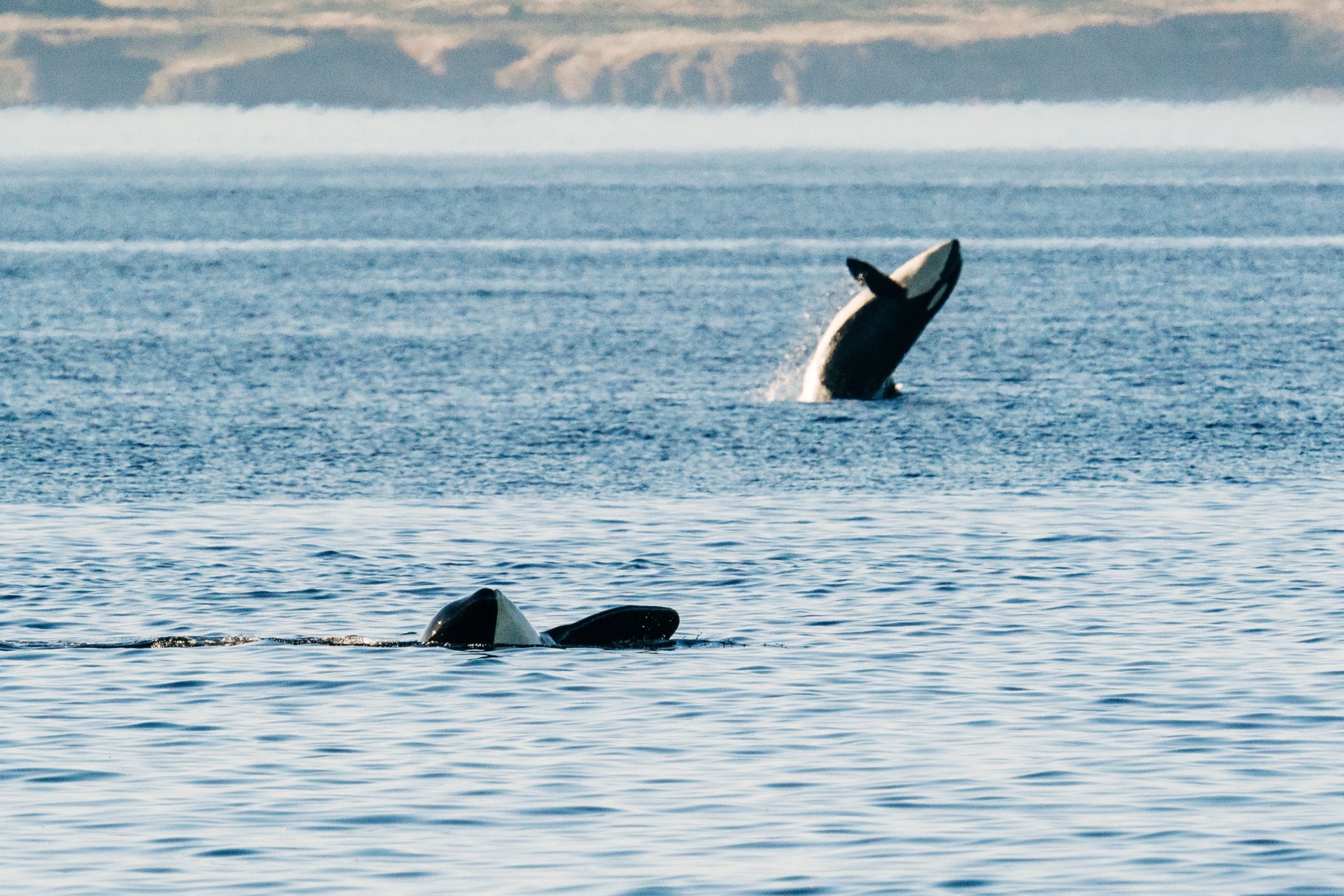
The baleen whales are generally huge and have the voices to match. The Odontoceti are much more varied in size and specialize in high-frequency sounds. But sound is just the beginning - what other superpowers do they possess?
Baleen whales
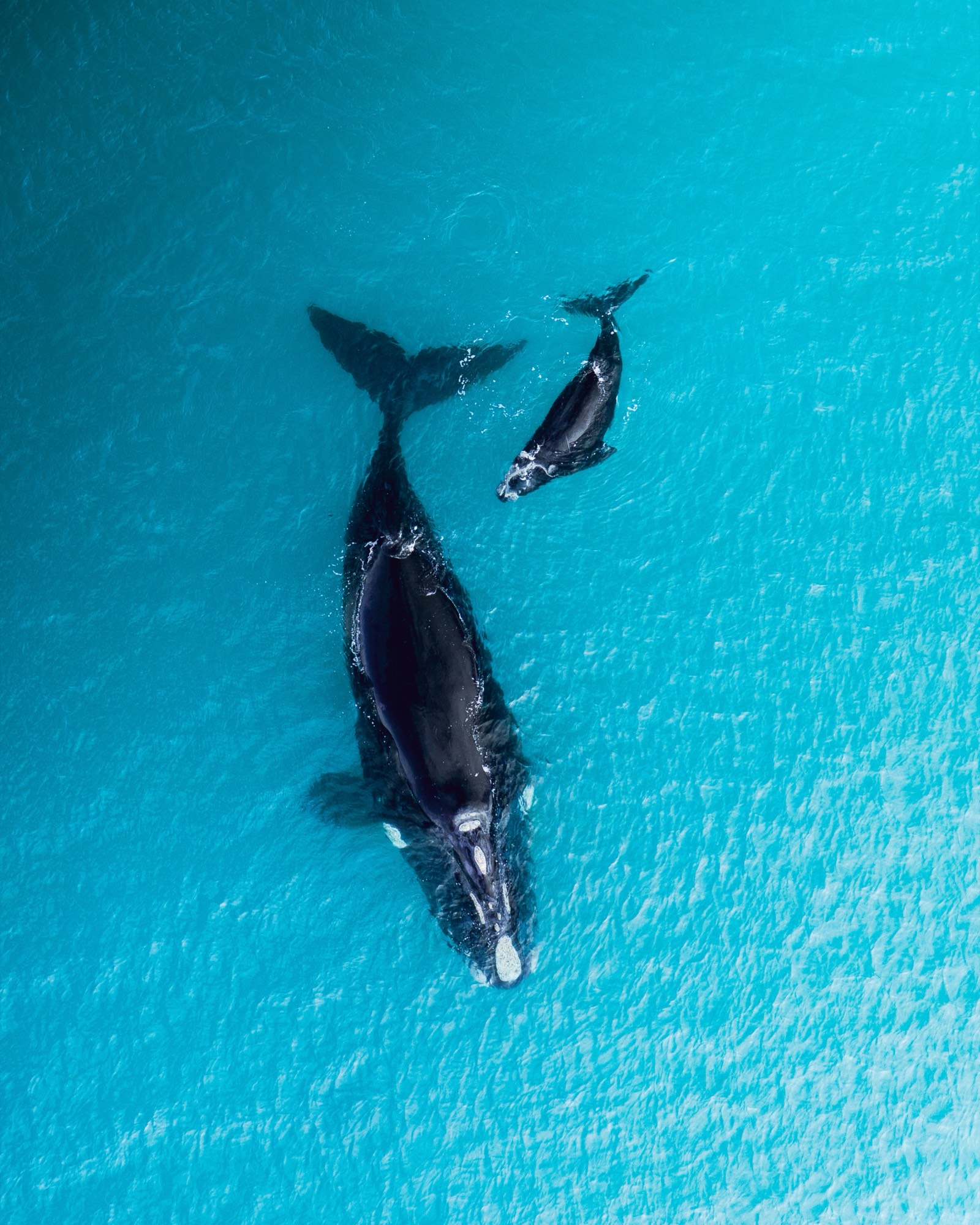
Baleen whales are the giants of the world. The largest (the blue whale) can reach more than 30 m long and weigh as much as 170 tons. Being this large, it seems an almost impossible task to get enough food to sustain oneself. The blue whale during feeding season needs several tons a day, with some estimates pointing to an incredible 16 tons a day. Baleen whales have solved this problem by developing baleen, which is a filtering structure attached to the upper gum. It consists of keratin (the same found in our hair and nails). Generally, baleen whales undergo long seasonal migrations and are fast swimmers (Sei whales have been recorded moving at 60km/hr.). Baleen whales generally move to high latitudes to feed on abundant zooplankton, though some also feed on small schooling fish. Ironically, the world’s largest animals feed on some of the smallest - however, in very high concentrations.
Baleen whales rarely assemble in large groups. Even in their often shared migration routes, they only sometimes have a travel buddy. They can, however, aggregate in large groups for feeding events, but rarely seem to be cooperating.
Baleen whales do not seem to echolocate. What they do is sing! Humpback whale songs are famous for including phrases and themes, making it actual music. The songs are shared across oceans and are evolving, thus resembling something like culture. Blue whales are of course remarkable in this arena too. Blue whales produce the loudest calls of any animal, up to nearly 190 dB moans. These moans may last more than 30 seconds and are very low frequency. In the right conditions, the moans might be heard over thousands of kilometers. They seem to serve a communication purpose, but they might have several purposes yet unknown to us.
Toothed whales
Odontoceti comes from Greek and means “toothed sea-monster”. The toothed sea-monsters are a much larger group than the Mysticeti, with at least 74 currently living species. They also come in all sizes. They range from the critically endangered 1,4m vaquita to the 18m long male sperm whale. The vaquita is a small porpoise living exclusively in the upper Gulf of California. According to the Marine Mammal Commission, there are about 10 left in the entire population. The biggest problem facing vaquitas is gillnets, which they become entangled in and drown. The vaquita is one of the most critical conservation assignments, and for them to survive, gillnetting must be halted in this area.
Most toothed whales are in the range of medium-sized cetaceans, somewhere between the vaquita and the orca (9- 10 m). Toothed whales target single prey items like fish, squid or other marine mammals like seals. The defining feature is echolocation, which is used to great effect in catching prey. Given the large size differences and large prey menu, the toothed whales differ much more than the baleen whales. Some hunt deep in the ocean (the sperm whale), while others seem to primarily use the upper layers (killer whales). Many toothed whales are not big enough to deter predators simply based on size. This means that they have to come up with alternative strategies to stay safe. One way to stay safe is through the formation of groups. Groups are helpful in many ways. It means more individuals to protect the group in active defense - or, in the case of sperm whales, the calves. It can also help through the dilution effect, which is when the group is so big that any one individual has a much smaller chance of being the unlucky one singled out and thereby increasing survival chances - likely a reason for the formation of the groups of thousands of dolphins. Another added benefit is the cooperation in catching prey. Killer whales cooperatively hunt seals and other large mammals and share the prey once incapacitated. Dolphins also regularly herd fish schools in cooperation.
Largest brains in the world
The largest brain in the world belongs to the sperm whale, with a brain about 9kg. This makes it about 60% larger than an elephant’s and 6 times larger than ours. Raw size of the brain is likely not the most important in terms of intelligence. Brain size tends to go up relative to body size. This makes sense given that the brain controls the body and needs to regulate functions of the cells. More cells = more brain to regulate them. However, some tissues, like blubber, don’t have as many functions. That is important because of the encephalization quotient or EQ. EQ is the ratio between observed and predicted brain mass based on the size of the body. The formula is arranged in a way that makes a score of 1 the average brain. A smaller average brain is less than 1 and a larger average brain is above 1. For instance, humans have the highest EQ at 7 and chimpanzees are at 2,5. Interestingly, delphinids have EQ’s as high as 3-5. EQ matters because the extra brain power in relation to body size is likely to give rise to fancier functions like higher thinking and high-level sensing (echolocation). These impressive brains naturally lead to the question: to what extent do whales feel?
The feeling giants
It is a very important question, but also one that is tricky to answer. It would be nice to simply be able to ask them. Something that a dolphin scientist named John Lilly did not actually think impossible. He thought that dolphins could be taught language. The research displayed the incredible mimicking abilities of dolphins but has yet to produce a real conversation. It did, however, open up the possibilities of high-level intelligence in something other than humans. In addition to the brain qualities discussed above, cetacean brains have an extensive level of folding (gyrification) of the brain’s outer layer, the neocortex. This folding surpasses all other animals and is associated with advanced cognitive functions. The presence of spindle neurons is also telling. Spindle neurons are found in brain regions that are linked to self-awareness and emotional processing in humans and are not found in most animals.
Couple these brains that seem to be able to feel and process at a high level with observations, and we begin to answer the question posed earlier. A frequently observed behavior in whales is the apparent grieving. An example is the killer whale mother who carried her dead calf on her rostrum for over two weeks. This is behavior that is hard to explain as anything other than grief, given that it goes against her survival instincts of feeding and conserving energy. Captive bottlenose dolphins also display something like depression, such as just lying on the floor of the pool, as a reaction to the death of a companion. Altruism is also seen. Humpback whales have been seen saving seals from killer whales. They shield them and even lift them out of the water on their bellies so the attackers cannot get to them. Why they do this is speculated upon. But for now we might call them heroic.
The shape and characteristics of the brain are compromises between adaptations and space. A specific adaptation is the enlarged hearing centers of the brain for toothed whales. One of the more fascinating things about the cetacean brain is the part of the forebrain called the cerebrum. The processing power of the brain is largely dependent on the number of neurons housed in this area. To allow for a larger surface area of the brain, it can fold (gyrification). The brain of cetaceans is heavily folded, which suggests impressive brain power. Also, connections between left and right brain hemispheres are quite weak compared to land mammals. They likely work more independently of each other for that reason, which makes sense considering that many cetaceans sleep with one hemisphere awake.